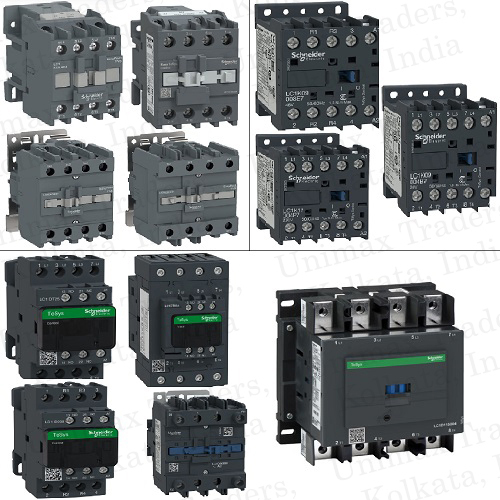
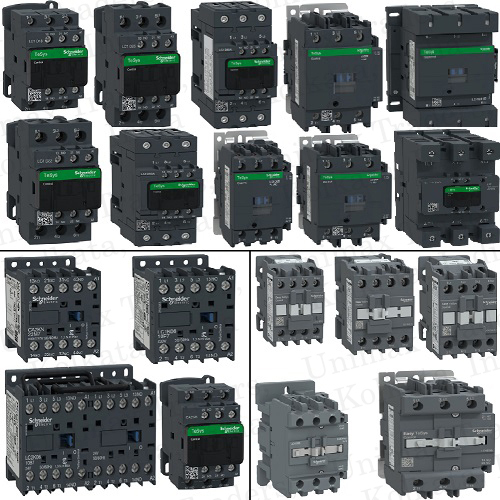
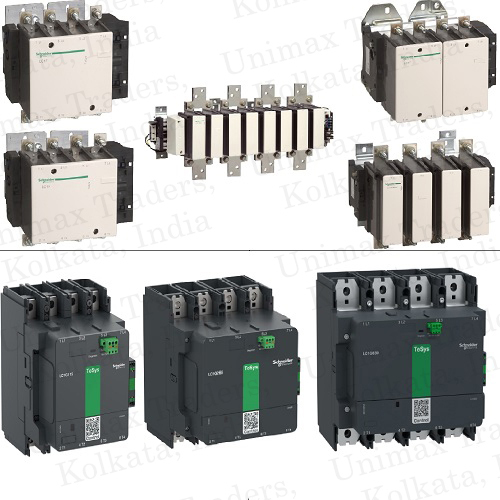
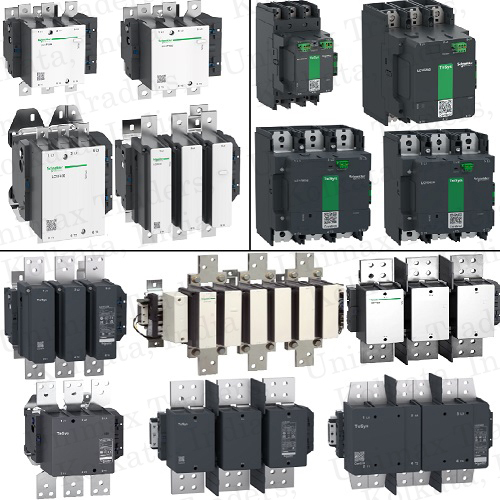
About Schneider Electric Contactor Tesys Deca 4 Pole 9 Amp To 250 Amp
A power contactor is an electrically operated, high-power switch that safely controls heavy electrical loads like motors, lighting, and heating systems by making or breaking connections in a circuit. It functions similarly to a relay but is built to handle significantly higher currents and voltages than standard relays, allowing a low-power control signal to indirectly operate a high-power circuit. Contactors ensure safety by isolating the control system from the high-power load and often include features for overload protection and remote operation.Versatile Performance for Industrial NeedsThe TeSys Deca LC1D Series contactors support a broad range of applications, from motor control to power switching in industrial automation. With rated operational currents spanning 9A to 250A and voltage compatibility up to 690V AC, these contactors adapt to multiple operational requirements. Auxiliary contacts, available as snap-on options, further broaden the scope for control and monitoring.
Reliable and Durable by DesignBuilt for longevity, the contactor offers a mechanical life of up to 10 million cycles and electrical endurance tailored to demanding environments-up to 1.1 million cycles in AC3 and 2 million in AC1 (at currents up to 32A). Its robust silver alloy contact material and finger-proof terminals enhance safety and reliability, making it a smart choice for heavy-duty operations.
FAQ's of Schneider Electric Contactor Tesys Deca 4 Pole 9 Amp To 250 Amp:
Q: How is the TeSys Deca 4 Pole contactor installed in control panels?
A: The contactor can be mounted either on a DIN rail or directly onto a panel, offering flexibility based on your enclosure's design. Its compact size ensures easy integration into most standard electrical panels.
Q: What auxiliary contact options are available for this contactor?
A: Selected models come with 1 NO + 1 NC standard auxiliary contacts, while others allow for optional snap-on auxiliary blocks to suit custom control requirements.
Q: When should I consider using a 4 pole contactor instead of a 3 pole type?
A: A 4 pole contactor is beneficial when additional switching is needed, such as neutral switching or synchronously controlling multiple circuits, which isn't possible with standard 3 pole devices.
Q: Where can the TeSys Deca contactor be used in industrial applications?
A: It is ideal for use in motor control centers, power distribution panels, and automation systems across manufacturing, infrastructure, and process industries.
Q: What benefits does the silver alloy contact material provide?
A: Silver alloy contacts deliver enhanced electrical conductivity, reduced contact wear, and improved performance over prolonged operational cycles, ensuring reliable switching even at high loads.
Q: How does the contactor handle voltage variations in control circuits?
A: The TeSys Deca accommodates control circuit voltages from 24V to 415V AC/DC, with coils designed for 50/60 Hz (AC types), making it suitable for various international and industrial power standards.
Q: What is the process for adding auxiliary contacts or replacing the coil?
A: Auxiliary contacts can be quickly snap-mounted onto the contactor, and coil replacement is straightforward due to the modular design-making maintenance efficient and minimizing downtime.
 Send Inquiry



 Send Inquiry

 Send Inquiry