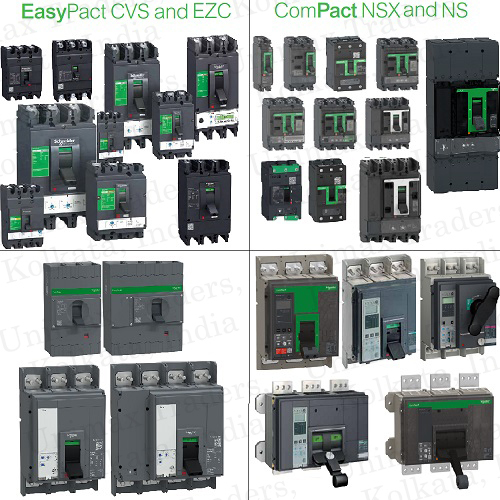
About Schneider Electric Mccb Compact Nsx Compact Ns Easypact Cvs Easypact Ezc
An MCCB, or Molded Case Circuit Breaker, is an electrical protection device that safeguards circuits from overcurrents (overloads and short circuits) by automatically interrupting the excessive current flow. Unlike smaller MCBs, MCCBs are designed for higher current applications, feature an adjustable thermal-magnetic trip mechanism for protection against prolonged overloads and sudden short circuits, and are housed in a robust, molded case for protection. They are widely used in industrial and large commercial settings to protect high-capacity equipment. Advanced Protection and VersatilitySchneider Electric's MCCB series delivers precise overload and short-circuit protection for electrical systems, available in both thermal-magnetic and electronic trip unit versions. Adjustable trip settings allow users to tailor protection levels to specific circuit demands. With IP40 protection and IP20 at terminals, these breakers ensure safety even in demanding environments, supporting reliable performance in industrial, commercial, and infrastructure projects.
Flexible Installation and AccessoriesThe Compact NSX, NS, Easypact CVS, and EZC breakers accommodate multiple installation types: fixed, plug-in, drawout, and-on select models-DIN rail mounting. This flexibility, combined with accessory compatibility such as shunt trips, undervoltage releases, auxiliary contacts, and rotary handles, enables seamless integration into existing or new electrical panels. This adaptability enhances usability across various applications and spaces.
Compliance and EnduranceMeeting IEC 60947-2 standards, these MCCBs assure operators of global conformity and reliability. They feature up to 20,000 mechanical and 10,000 electrical operations, making them suitable for long-term service. Available in 1, 2, 3, or 4-pole configurations and covering a wide current and voltage range, they are ideal for diverse Indian industrial, commercial, and infrastructure needs.
FAQ's of Schneider Electric Mccb Compact Nsx Compact Ns Easypact Cvs Easypact Ezc:
Q: How do I select the appropriate Schneider Electric MCCB for my application?
A: Selection depends on your system's rated current requirements (16A-1600A), number of poles (1, 2, 3, or 4), and breaking capacity (up to 150kA). Also, consider your installation style (fixed, plug-in, drawout, or DIN rail), required accessories, and operating environment. These circuit breakers are suitable for industrial, commercial, and infrastructure applications in India.
Q: What are the key benefits of using Schneider Electric MCCBs with thermal-magnetic or electronic trip units?
A: Thermal-magnetic trip units offer reliable overload and short-circuit protection, while Micrologic electronic trip units provide advanced diagnostics and adjustable settings for enhanced circuit protection. Both options ensure faster response to faults, minimizing equipment damage and downtime.
Q: Where can I install these MCCBs, and what mounting options are available?
A: These MCCBs can be panel-mounted and, for select models, installed on DIN rails. Installation methods include fixed, plug-in, and drawout, allowing seamless integration into new or existing switchboards in industrial, commercial, or infrastructure settings.
Q: What accessories are available, and how do they enhance breaker functionality?
A: A wide range of accessories is available, such as shunt trip units, undervoltage releases, auxiliary contacts, rotary handles, and padlock provisions. These additions enable remote tripping, enhanced safety, improved monitoring, and flexible operation tailored to project needs.
Q: What makes Schneider Electric MCCBs compliant with international standards?
A: These breakers adhere to IEC 60947-2 standards for low-voltage switchgear, ensuring they meet stringent safety, reliability, and performance criteria required internationally as well as within India.
Q: How does the contact position indicator and padlock provision improve safety?
A: The ON/OFF/TRIP contact position indicator provides clear status visibility, reducing the risk of operational errors. Padlock provisions allow secure lockout during maintenance, enhancing operator safety and compliance with safety procedures.
 Send Inquiry


 Send Inquiry

 Send Inquiry